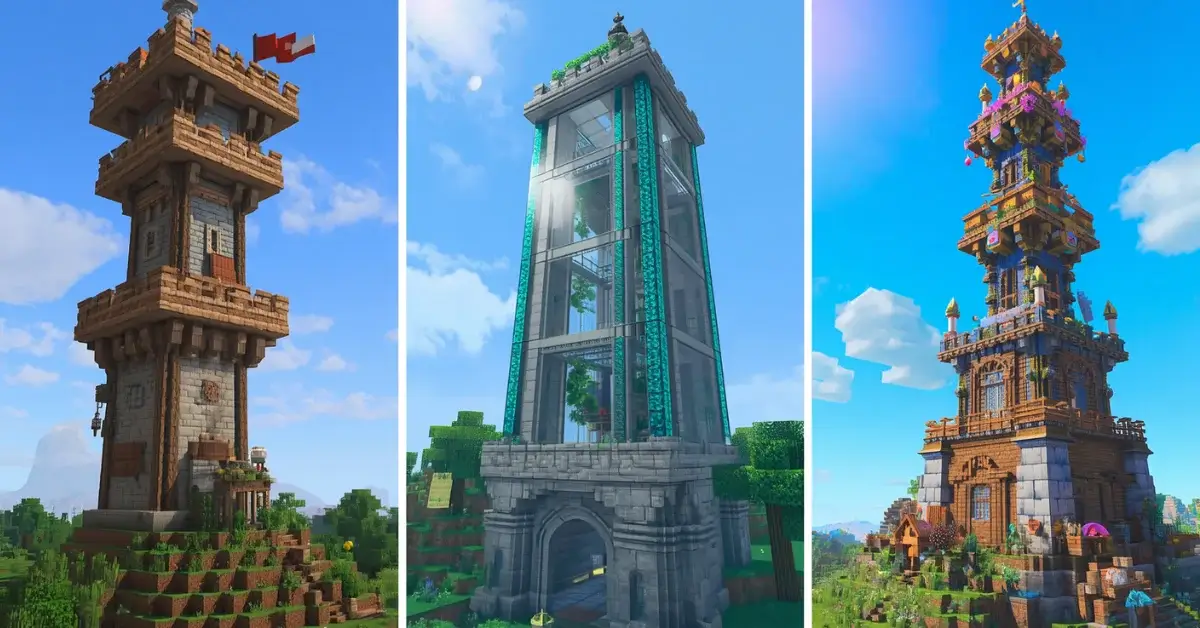
Best Minecraft Tower Designs Using Circles
A round cross-section changes a tower more than almost any other single decision. Here’s how to size, taper, and roof one across medieval, modern, and fantasy styles.
Square towers are quick to build, but round ones are what get screenshotted. Part of that is simply rarity — most builders default to square because it needs no planning, so a round tower already stands out before a single decorative block goes down. The bigger reason is that a circular cross-section forces every floor to be planned rather than thrown up freehand, and that extra bit of care shows in the finished result. You can’t eyeball a curved wall the way you can a straight one; every row has to be counted against the floor below it, which naturally produces a tighter, more deliberate structure.
Below are the design decisions that shape how a round tower reads before you place a single decorative block, followed by three full tower styles built around different circle sizes and roof shapes, and a set of details — windows, multi-tower complexes, common mistakes — that apply regardless of which style you build.
The four decisions that shape every round tower
Diameter — and whether it stays constant
A straight cylinder tower (same diameter top to bottom) reads as sturdy and defensive. A tower that tapers — shrinking its diameter every few floors — reads as tall and elegant, closer to a real-world spire. Tapering works best in small, deliberate steps: shrink by 2 blocks in diameter every 4–6 floors rather than continuously, so each section still reads as a clean cylinder rather than a rough cone. Continuous, floor-by-floor shrinking almost never looks intentional — it tends to read as a mistake rather than a design choice, since the eye can’t distinguish a deliberate taper from a series of small errors at that resolution.
Wall thickness
A tower built as a single-block-thick ring looks thin and fragile from outside, and it also limits what you can build into the wall itself. Building the outer wall two blocks thick — an outer decorative layer and an inner structural layer — gives room for window recesses, torches, and trim detailing that a paper-thin wall can’t support. It also means an interior floor doesn’t need to butt directly against the exterior texture, which keeps the inside from feeling like it’s pressed against the outside skin of the building.
Floor-to-floor rhythm
Every few floors, most towers benefit from a small visual break — a projecting ledge, a change in wall block, a band of windows — rather than one continuous uninterrupted wall from base to roof. Real-world towers almost never read as a single unbroken surface; they have string courses, window bands, and material changes that mark the passage of each level. A round tower with no such breaks tends to look like a silo rather than a habitable structure, no matter how correct the circle math underneath it is.
The roof
The roof is what turns a round wall into a recognizable “tower.” A cone (a shrinking stack of circles narrowing to a point) suits medieval and fantasy styles. A dome (the same shrinking pattern, but stopping at a rounded peak instead of a sharp point) suits modern and observatory styles. A flat capped roof with a decorative parapet suits fortress and defensive designs. The roof’s diameter should match the tower’s top floor exactly — a roof narrower or wider than the wall beneath it is one of the most common reasons an otherwise well-built tower looks slightly wrong without it being obvious why.
| Style | Taper | Roof | Feel |
|---|---|---|---|
| Medieval | None (straight cylinder) | Cone | Sturdy, defensive |
| Modern | Slight | Dome | Sleek, architectural |
| Fantasy | Aggressive | Sharp peak | Tall, dramatic |
Medieval watchtower
Keep the diameter constant for a fortified, defensive look. Use stone brick or cobblestone for the walls with a darker roof material — dark oak or dark prismarine — for the cone. Add a ring of crenellations (alternating raised blocks) just below the roofline for a classic parapet.
Pro tip: break the wall’s monotony with a single projecting ring of stone (a corbel) two-thirds of the way up, wide enough to stand a torch or banner on — real watchtowers almost always have a mid-height feature like this, and its absence is part of why a plain cylinder can read as unfinished.
Modern glass spire
Use quartz, white concrete, or light-colored blocks for the walls, break up the round facade with horizontal glass banding every 3–4 floors, and cap it with a glass dome rather than a cone for an observatory or penthouse feel. A slight taper — losing a couple of blocks in diameter over the full height — keeps the modern silhouette from looking boxy.
Pro tip: keep the glass banding perfectly horizontal all the way around the curve, even though it means the band will step slightly at each block on the circle’s outline — a banding pattern that tries to follow the curve’s stair-steps instead of staying level ends up looking broken rather than sleek.
Fantasy wizard’s spire
Start narrow and taper more aggressively than the other two styles — losing diameter every 3–4 floors — for a tall, thin silhouette. Use dark or purple-tinted blocks, add glowing accents (sea lanterns, glowstone behind stained glass) at irregular window heights, and finish with a steep, narrow cone roof rather than a wide dome.
Pro tip: stagger the glowing window heights so no two are level with each other around the tower — perfectly aligned windows read as orderly and modern, while irregular heights read as an old, organically-grown structure, which suits the fantasy tone far better.
Get the exact circle for any base diameter, and the matching dome or cone layers for the roof.
Open the Circle GeneratorWindows on a curved wall
Windows on a round tower need to follow the curve’s natural block pattern rather than being placed at arbitrary points — cutting a window where the wall is only one block deep (a natural gap in the outline) looks intentional, while cutting one through a thicker section looks like a hole was punched through. Plan window placement against the same blueprint you used to build the wall, and keep window rows aligned to the same floor level all the way around for a consistent, deliberate look.
It’s also worth deciding on a window rhythm before placing any of them — every other outline block, every third, or clustered in pairs with gaps between — and keeping that rhythm consistent floor to floor. A tower with a different window spacing on every level reads as improvised, even if each individual floor looks fine on its own.
Multi-tower complexes
A single round tower is a strong standalone build, but round towers are also one of the easiest shapes to repeat at varying sizes to form a larger complex — a castle with four corner towers at a matching diameter and one larger central keep tower, for instance. Keeping every tower’s diameter an exact multiple or fraction of the others (all built from odd or all from even diameters) makes the whole complex read as designed rather than assembled from mismatched pieces.
Round corner towers also pair naturally with a square or rectangular main structure — this is one of the most common combinations in real castle architecture, and it works just as well in Minecraft. The straight walls give you fast, simple construction for most of the building, while the round towers at the corners or entrance carry the visual interest. Just keep the roof style consistent across every tower in the complex; mixing cones on some towers and domes on others tends to read as unplanned rather than varied.
Planning the interior of a round floor
A circular floor plan looks great from outside but catches builders off guard on the inside, since almost every piece of furniture and most redstone contraptions are built for straight walls. The fix isn’t to avoid furniture against the curve — it’s to accept that the outermost ring of a round floor will always have some irregular, non-rectangular space, and to plan for it rather than fight it. Push beds, chests, and crafting stations one block in from the curved wall so they sit against a flatter section of floor, and reserve the awkward wedge-shaped gaps right against the curve for plants, rugs, or simple decoration where an irregular shape doesn’t matter.
For multi-floor towers, it’s worth deciding early whether each floor’s interior will be fully open (one large circular room) or split into wedge-shaped sections with interior walls radiating out from a central point, similar to slices of a pie. Split layouts work well for towers with a specific function per floor — a library level, a bedroom level, a storage level — while open layouts suit towers meant to feel grand or ceremonial, like a great hall or a throne room at the base of a keep.
Common tower design mistakes
- Tapering continuously instead of in deliberate steps — a tower that shrinks every single floor looks like an error, not a design choice; taper in clear 4–6 floor sections instead.
- Mismatching the roof diameter to the top floor — even a one-block gap between the wall’s top ring and the roof’s base ring is immediately visible once the roof curves inward.
- Leaving a single-block-thick wall with no room for detail — window recesses, trim, and torches all need wall depth to sit in properly.
- Placing windows without a consistent rhythm — random spacing floor to floor reads as unplanned even when each floor looks fine individually.
- Skipping any mid-height visual break — a tower with zero ledges, bands, or material changes from base to roof tends to read as a silo rather than a building.
Frequently asked questions
What’s the best diameter for a Minecraft tower? +
9–11 blocks suits a small watchtower or garden feature, 15–21 blocks gives real usable interior floor space for a home or keep, and 25 blocks or more starts to feel like a main structure rather than an accent. Taller towers generally read better with a slightly wider base, since a very tall thin cylinder can look unstable even though nothing about it is structurally wrong in-game.
Should a tower’s diameter stay the same from base to roof? +
It depends on the style. A constant diameter (a straight cylinder) reads as sturdy and defensive, which suits medieval or fortress designs. A gradual taper, losing a couple of blocks every several floors, reads as elegant and suits fantasy spires or modern towers. Both are valid; the choice should match the tone of the build, not just personal preference.
How do I stop a round tower’s windows from looking randomly placed? +
Plan windows against the same circle blueprint used to build the wall, cutting them at points where the wall is naturally thinner rather than at arbitrary spots, and keep every window at the same floor height as you go around the tower. Randomly placed windows are one of the fastest ways to make an otherwise clean round tower look unplanned.
Can round towers work with a square or rectangular main building? +
Yes — round corner towers on an otherwise square or rectangular structure is one of the most common combinations in both real-world castle architecture and Minecraft builds. The contrast between straight walls and round towers reads as intentional rather than mismatched, especially when the towers share a consistent roof style with each other.
6 thoughts on “Best Minecraft Tower Designs (Medieval, Modern, Fantasy)”