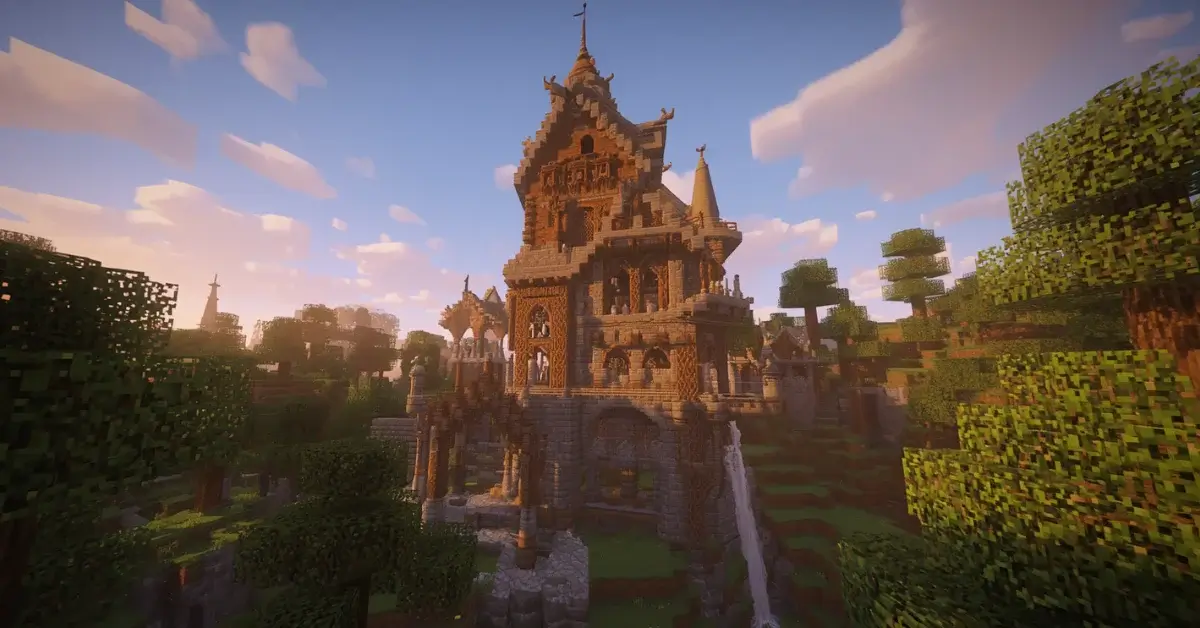
Minecraft Wizard Tower Build Guide
A wizard tower works off the same circular tower fundamentals as any other round build, but pushed toward narrower proportions, a steeper taper, and details that read as magical rather than defensive. Here’s how each piece contributes to that effect.
The difference between a wizard tower and a regular round tower isn’t a different building technique — it’s the same circular-shaft-plus-roof method used for any tower, deliberately pushed toward narrower, taller, and more aggressively tapered proportions than a defensive or residential tower would use. A wizard tower’s whole visual identity depends on looking slightly impractical and top-heavy, which is exactly the opposite instinct from building a sturdy watchtower.
Base diameter: narrower than usual on purpose
7 to 9 blocks in diameter is the standard range for a wizard tower’s base, noticeably narrower than the 13–15 block range that suits a general-purpose round tower. This narrowness is doing real work — a wide-based tower reads as sturdy and grounded, while a narrow one reads as precarious and reaching upward, which fits the archetype of a tower built for a single reclusive occupant rather than a garrison. The narrow diameter does mean minimal interior floor space per level, which is a reasonable trade-off for the silhouette this build is going for.
Height and taper: tall, thin, and shrinking as it rises
Where a lighthouse tapers gently and a defensive tower might not taper at all, a wizard tower benefits from a more aggressive taper — losing a block or two of diameter every 3–4 floors rather than every 5–6. Combined with real height (10+ floors is common for this style), the aggressive taper produces the tall, narrowing spire silhouette that reads instantly as “wizard tower” in a way a straight cylinder of the same height doesn’t. Each taper step should still use a clean, deliberately sized circle rather than an improvised shrink — dropping from an 9-block floor to a 7-block floor directly above it, for instance, rather than an uneven reduction that doesn’t correspond to a real circle diameter.
Plan each tapered floor’s exact circle before building upward — get the blueprint for any diameter in the sequence.
Open the Circle GeneratorRoof: a steep cone beats a dome for this style
A steep, narrow cone — tapering to a single point over roughly 5 to 7 blocks of height — reads as more classically fantasy than a rounded dome, which tends toward an observatory or scientific feel instead. The cone’s steepness matters more than its exact material: a gentle, low-angle cone looks closer to a lighthouse roof, while a tall, sharply-angled one immediately signals fantasy architecture. Dark or unusual roofing colors — deep purple, black, or dark blue stained glass or concrete — reinforce the effect further than a standard red or brown roof would.
Windows: irregular, not evenly spaced
A defensive tower benefits from evenly spaced windows at consistent floor heights, since it reads as organized and functional. A wizard tower benefits from the opposite — windows placed at irregular heights and slightly varied positions around the tower feel more organic and less architecturally planned, which suits a structure imagined as built or grown over a long, eccentric period rather than constructed to a standard blueprint in one project.
Adding a magical glow
Placing a light source — glowstone or sea lanterns work well — directly behind a layer of stained glass, rather than leaving it exposed, produces a soft colored glow through the glass instead of a harsh direct light point. This is one of the highest-impact, lowest-effort details available for this build: a handful of glowing windows at irregular heights does more to sell the “magical” feeling than almost any other single addition, and it costs very little in materials or time relative to its visual impact.
Exterior details worth adding
- Climbing vines or overgrown vegetation partway up the tower suggest age and a lack of conventional maintenance.
- Small floating or attached platforms jutting out from the tower at irregular heights, sometimes without an obvious purpose, add to the sense of eccentric construction.
- A single prominent balcony or observatory ledge near the top gives the tower a focal point besides the roof itself.
- Asymmetrical additions — a smaller attached turret, an external staircase, or a lopsided extension — break up the tower’s otherwise clean circular symmetry in a way that reads as intentional character rather than a mistake.
Interior layout for a narrow tower
At 7–9 blocks in diameter, interior floor space is genuinely limited, which suits a wizard tower’s themed use anyway — a single-purpose room per floor (a library floor, a potion-brewing floor, a sleeping floor) works better here than trying to fit multi-function rooms into a cramped circular footprint. A ladder or narrow spiral staircase along one wall is usually the only realistic vertical access option at this diameter, which is consistent with the tower’s slightly impractical, form-over-function character.
Surrounding the tower appropriately
A wizard tower rarely stands convincingly in the middle of an ordinary village — it reads better isolated in a forest clearing, at the edge of a swamp, on a rocky outcrop, or connected to a small walled garden with unusual plants. The immediate surroundings do almost as much work as the tower itself in selling the fantasy setting, since a technically well-built tower dropped into a mismatched environment still reads as out of place.
Common mistakes with this build
- Building it too wide. A 13+ block base diameter starts looking like a standard round tower regardless of roof or window choices — narrowness is doing a lot of the identifying work here.
- Evenly spaced, symmetrical windows. This reads as a defensive or civic tower rather than an eccentric wizard’s dwelling.
- Skipping the glow detail entirely. A structurally correct wizard tower with no glowing windows or magical light accents often still reads as a generic fantasy tower rather than specifically a wizard’s tower.
- A gentle, low taper. Without the aggressive narrowing taper, the tower loses the tall, precarious silhouette the style depends on.
Choosing a color palette
Dark, cool-toned materials generally suit this style better than the warm browns and grays common on medieval towers. Deepslate, blackstone, dark oak, and purple-tinted blocks (purpur, amethyst-adjacent colors) all read as more mystical than standard stone brick or cobblestone. A tower built entirely from one dark material can look flat, though — mixing in a lighter secondary material for trim, window frames, or a banding detail keeps the structure visually readable rather than becoming a uniform silhouette against the sky. Purple or blue accents specifically tend to read as “magical” more reliably than other color choices, which is why they show up so often in this style regardless of the exact block palette used.
A practical build order
As with any tapered tower, deciding the full height and every taper step before placing blocks avoids the most common source of rework. Lay out the base circle first — 7 or 9 blocks, using the anchor-point and quadrant-mirroring method — then build upward in matched sections between taper points, placing irregular windows as you go rather than adding them afterward, since retrofitting irregular openings into a finished wall is harder to get looking natural than planning their positions during construction. Add the glow details (stained glass with a light source behind it) at the same time as each floor’s windows, since accessing the wall from outside is easier mid-build than after the roof has closed the tower off from above.
Comparing wizard towers to other fantasy archetypes
A wizard tower sits at one end of a spectrum of fantasy tower styles. An elven or druidic tower typically integrates more organic materials — wood, leaves, and vines woven into the structure itself rather than added as an afterthought — and often skips the sharp cone roof for something rounder or more irregular. A necromancer or dark-sorcerer variant leans further into asymmetry, decay, and very dark or bone-colored materials, sometimes abandoning the clean circular cross-section entirely in favor of a more jagged, irregular footprint. The standard wizard tower described in this guide sits in the middle — clean circular geometry with mystical color and lighting details layered on top — which makes it a reasonable starting point to adapt toward any of these more specific variants.
Quick material reference
| Section | Suggested materials | Purpose |
|---|---|---|
| Main shaft | Deepslate, blackstone, dark oak, purpur | Cool, mystical base tone |
| Trim / bands | Amethyst blocks, light purple or blue concrete | Breaks up a flat dark silhouette |
| Windows | Purple or blue stained glass | Colored glow, irregular placement |
| Light behind glass | Glowstone, sea lantern | Soft glow rather than harsh direct light |
| Roof cone | Dark concrete, black wool, dark prismarine | Steep, dramatic silhouette |
Finishing touches
A scattering of floating candles or particle-suggesting light blocks near the top, an attached small greenhouse or alchemy garden at the base growing unusual plants, and a winding, slightly overgrown path leading to the entrance all reinforce the sense that the tower belongs to someone with a long, idiosyncratic history at that location rather than having been built to a standard template. None of these require changing the tapered circular shaft method described above — they’re additions layered onto the same core structure.
Balancing atmosphere with practicality
It’s worth keeping enough conventional light sources near ground level and around any outdoor platforms even on a moody, dimly-lit tower, since low light levels outside allow hostile mobs to spawn nearby at night regardless of how thematically appropriate the darkness is. The glowing stained-glass windows described earlier help with this indirectly, but a few unobtrusive lanterns or glowstone blocks tucked into the surrounding garden or path keep the immediate area safe without undermining the tower’s moodier aesthetic above.
Building a wizard tower is ultimately an exercise in restraint as much as decoration — the narrow diameter, aggressive taper, and irregular details described throughout this guide all work by deliberately breaking from the more balanced, symmetrical proportions that suit a defensive or civic tower. Leaning into that asymmetry consistently, rather than reintroducing evenly-spaced windows or a wide stable base partway through the build, is what keeps the finished structure reading as a coherent style rather than a tower that changed its mind halfway up.
Frequently asked questions
What diameter should a Minecraft wizard tower be? +
7 to 9 blocks at the base — narrower than a typical round tower, which is part of what gives it a tall, spindly fantasy silhouette.
Should a wizard tower have a cone or a dome roof? +
A steep, narrow cone reads as more classically fantasy than a dome, which tends to look more like an observatory. A cone tapering over 5 to 7 blocks of height suits the proportions well.
How do you add a magical glow to a wizard tower? +
Placing glowstone or sea lanterns behind stained glass at irregular window heights creates a soft glow through the glass, which reads as more magical than exposed light sources.