Odd vs Even Circle Diameters in Minecraft — Which to Choose
This decision gets skipped more than almost any other in circle building, and it’s the reason a perfectly round circle can still look wrong once something is placed at its center. Here’s how to choose correctly the first time, shown visually.
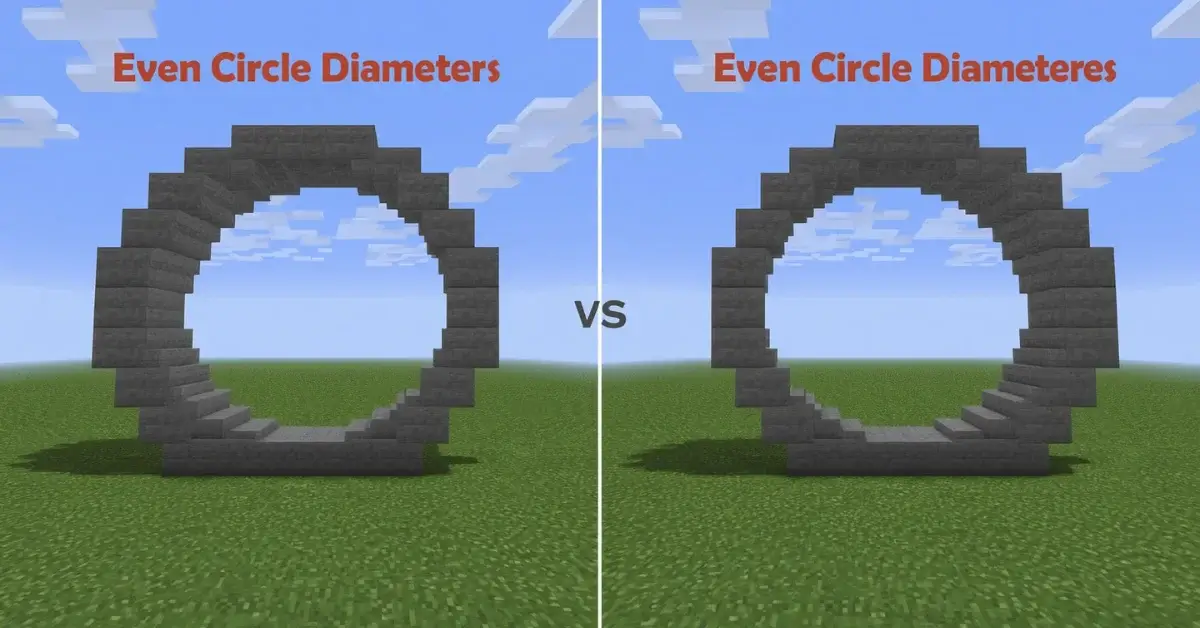
Odd and even diameters produce circles that are equally round — the size of the number, not whether it’s odd or even, is what determines how smooth a circle looks. What odd and even actually change is the shape’s exact center: an odd diameter has a true single center block, while an even diameter has a two-block center line instead of one point. That difference sounds small until it collides with a specific build requirement, and by then the fix usually means tearing down and rebuilding the outline from scratch.
The amber cells mark the true center of each grid — a single block on odd widths, a small cluster on even widths.
What actually changes between odd and even
Take an 11-block circle and a 12-block circle as a direct comparison. The 11-block circle has a radius of 5.5, which places one exact block at the mathematical center — that block sits equidistant from every point on the ring. The 12-block circle has a radius of 6, and its center falls exactly between four blocks rather than inside any single one of them, creating a two-by-two center area instead of a single point. Neither circle is more accurate or more “correct” than the other; they’re just built around a different kind of middle.
When odd diameters are the right choice
Odd diameters (7, 9, 11, 15, 21…) are the better fit whenever a build needs one specific block to sit dead-center. A beacon needs a single base block directly underneath its beam. A ladder or vine column running up the middle of a tower needs one column, not two side by side. A spiral staircase’s central newel post is a single vertical line. A single decorative block — a lantern, a flower pot, a campfire — reads as centered only when there’s actually one block position at the true middle to place it on. In every one of these cases, an even diameter forces an awkward choice between two equally “almost centered” blocks, neither of which is actually the mathematical center.
When even diameters are the right choice
Even diameters (8, 10, 12, 16, 22…) work better whenever the build’s focal point is a line rather than a point, or when there’s no single focal point at all. Double doors need two adjacent blocks to open outward from, which lines up naturally with an even diameter’s two-block center. A walkway or bridge splitting a circular plaza in half sits more naturally on a center line than trying to route it past a single obstructing center block. Wide, open rooms without any specific central fixture also tend to feel less constrained on an even diameter, since there’s no single block anyone’s eye gets drawn toward — and no risk of that single spot ending up occupied by something plain like a random floor block.
Generate the exact grid for any diameter and see the center point directly, odd or even, before committing to a size.
Open the Circle GeneratorA side-by-side comparison
| Factor | Odd diameter | Even diameter |
|---|---|---|
| Center | Single block | Two-block center line |
| Best for | Beacons, ladders, single center pieces | Double doors, walkways, wide open rooms |
| Roundness | Same as equivalent even size | Same as equivalent odd size |
| Symmetry axis | Through the single center block | Through the middle of the center line |
| Common mistake | Using odd when a symmetrical double feature is needed | Using even when a single focal block is needed |
Why this matters more on multi-floor builds
A single-floor circle can get away with picking odd or even somewhat loosely, since the center point only matters for whatever sits directly on that floor. A multi-floor tower is a different situation entirely — every floor shares the same vertical centerline, so switching between odd and even diameters floor to floor means that shared centerline shifts by half a block relative to whichever floor changed. This rarely causes a visible problem with the outer walls, since the circle itself still looks round at any size, but it becomes a real issue the moment something needs to line up vertically through multiple floors — a ladder shaft, a support pillar, or a spiral staircase core running from the ground floor to the roof. Keeping every floor of a single connected structure consistently odd, or consistently even, keeps that vertical alignment clean without extra planning at each level.
Concentric circles need matching parity too
Builds that use multiple circles sharing one center point — a tower inside a courtyard wall, or a field oval inside a track oval inside a seating ring — run into the same alignment issue horizontally instead of vertically. If the inner circle is odd and the outer one is even, their two center references don’t land on the same point, which can leave the rings looking slightly off-center relative to each other even when each individual ring is perfectly built. Matching the parity (odd-with-odd, or even-with-even) across every ring in a concentric design keeps them all sharing the exact same middle.
Practical shortcuts for deciding quickly
- Something specific belongs at dead-center? Go odd.
- The build needs symmetrical double features (doors, windows, paths) rather than a single centerpiece? Go even.
- Building a multi-floor structure? Pick one parity for the whole structure before laying out the first floor.
- Building several concentric circles around a shared center? Match parity across all of them.
- None of the above applies? Either works — pick based on which specific diameter gives the best size for the build, using the size chart as a starting point.
The one thing parity doesn’t affect
It’s worth repeating because it’s the most common misunderstanding on this topic: odd versus even has no bearing on how smooth or blocky a circle looks. That’s controlled entirely by diameter size, as covered in the size chart and the delta explainer — a small rounding gap exists at every size, odd or even, and it shrinks in relative terms as the circle gets larger regardless of which parity was chosen. Odd and even is purely a decision about what sits at the middle, never about the quality of the curve itself.
A worked example: a beacon monument gone wrong
A common mistake plays out like this: a builder picks a 20-block diameter for a beacon monument because it fits the available space, places the outer ring, then reaches the center only to find there’s no single block to put the beacon on — just four blocks meeting at a point. The beacon ends up shifted one block off the true center to make it fit on an actual block, which is a small compromise on paper but becomes visually obvious once the surrounding platform is built symmetrically around what’s now a slightly off-center beacon. Switching to a 21-block diameter instead — same general size, opposite parity — would have placed a single block exactly at the center where the beacon needed to sit, avoiding the compromise entirely. The lesson isn’t that 20 is a bad number; it’s that the diameter should be chosen with the center requirement in mind from the start, not adjusted after the ring is already built.
Spheres and domes inherit their base circle’s parity
A sphere’s middle layer is just a circle, and that circle’s odd-or-even choice carries the same consequences upward and downward through every layer above and below it. An odd-diameter sphere has a genuine single-block core at its exact center, useful for a light source or a structural pillar running through the whole shape. An even-diameter sphere’s core is a small cluster of blocks instead. The same logic applies to a dome’s base ring — an odd base diameter gives the dome a single centerline running straight up to the peak, which matters if the dome needs to align with a specific point on the structure underneath it, like a tower’s central stairwell continuing upward through the roof.
Why this gets overlooked so often
Most builders think about circle size first — does it fit the available space, does it look proportionate — and only notice the center-point problem once they’re standing in the middle of a finished ring trying to place something specific. Odd-versus-even isn’t a visible property the way size is; nothing about looking at a blank circle from the outside signals which parity it has, so it’s easy to skip the decision entirely and let the diameter get picked for other reasons first. Making parity part of the initial planning step, alongside size, is really the only fix — checking a generator’s grid for where the exact center falls before finalizing a diameter takes a few seconds and avoids the entire category of mistake.
Does this apply the same way to ovals?
Ovals have two independent measurements — width and height — and each one can be odd or even on its own, which means an oval can land on any of four center configurations: both odd (single center block), both even (center line in both directions), or one of each (center line in only one direction). The same reasoning applies to each axis independently: if a specific feature needs to sit at the oval’s exact middle, check both the width and height parity against what that feature actually requires, rather than assuming an oval automatically inherits clean centering just because a circle would.
A quick reference for common center-point needs
| What sits at the center | Best parity | Why |
|---|---|---|
| Beacon, single light source | Odd | Needs exactly one block underneath it |
| Ladder or vine column | Odd | A single vertical line, not a 2-wide gap |
| Spiral staircase newel post | Odd | One central post the stairs wind around |
| Double doors | Even | Two adjacent blocks to open outward from |
| Split walkway or bridge | Even | A natural center line to build along |
| No specific centerpiece | Either | Pick based on size alone |
Checking parity before you commit to a diameter
Since parity is invisible on a blank, unbuilt circle, the only reliable way to confirm it before construction is to check a generator’s grid output for the intended diameter and look at what actually sits at the middle. This takes a few seconds and catches the mistake at the cheapest possible point — before any blocks have been gathered or placed — rather than discovering it only once the ring is finished and something needs to go in the center that doesn’t fit the available space there. Making this check a standard part of the planning stage, alongside picking the diameter itself, is a small habit that prevents the single most common source of avoidable rework across circular builds of every size, from a small garden fountain up to a multi-floor tower shared by an entire base, and it costs nothing more than a quick look at the generator before the first block goes down.
Frequently asked questions
Should a Minecraft circle diameter be odd or even? +
It depends on what sits at the center. An odd diameter gives a single center block, ideal for a beacon, ladder, or staircase core. An even diameter gives a two-block center line, better suited to double doors or a build with no single focal point.
Does odd or even affect how round a circle looks? +
No. Roundness depends on diameter size, not parity. A 15-block and a 16-block circle look equally round; the difference is only what sits at the exact center.
Can a tower switch between odd and even diameters floor to floor? +
It can, but it shifts each floor’s center point relative to the one below it. Keeping every floor consistently odd or even keeps the whole structure’s vertical centerline aligned.