How to Build an Oval or Ellipse in Minecraft — Full Guide
An oval is a circle that stopped agreeing with itself about how wide to be — width and height set independently instead of one shared diameter. Same underlying method, one extra number to plan around.
A circle uses one number — diameter — for every direction. An oval uses two: a width and a height that can differ from each other, stretching the shape along one axis while keeping the other more compact. Every technique already familiar from circle building — anchor points, quadrant mirroring, odd-versus-even center decisions — still applies to an oval directly, just calculated against two radius values instead of one shared radius.
Seeing width and height independently
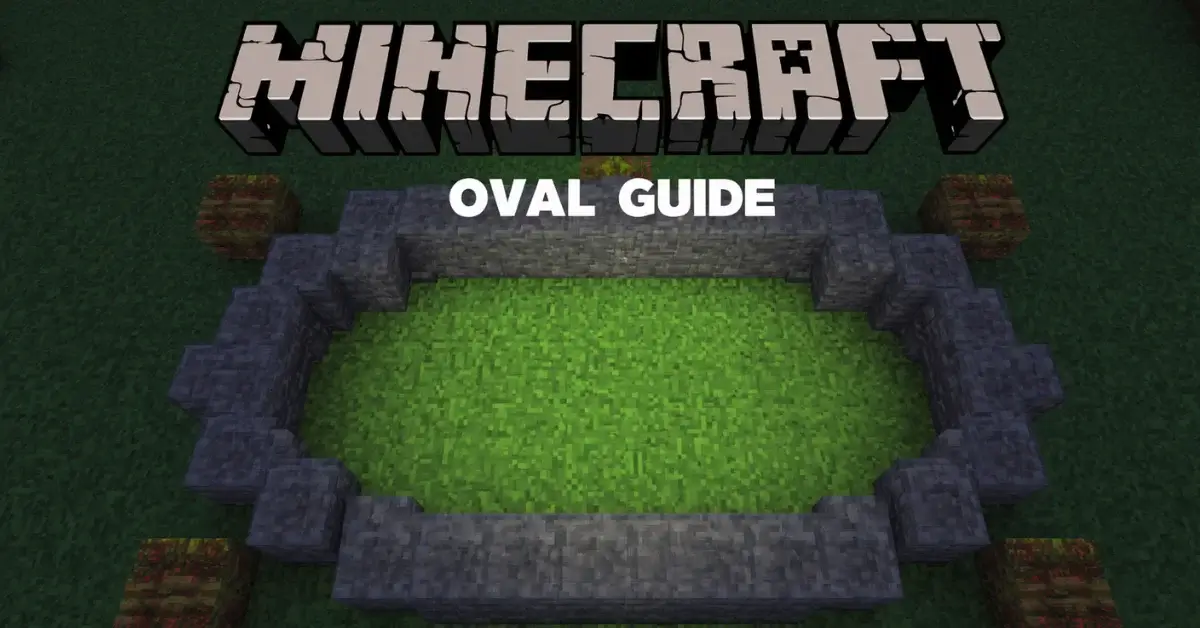
The diagram below shows a 15×9 oval — 15 blocks wide, 9 blocks tall. Notice the curve is noticeably flatter across the top and bottom than a plain circle of either dimension would be; that flattening is exactly what width and height being different values produces.
Picking a ratio that actually reads as an oval
A ratio too close to 1:1 doesn’t read as an intentional oval — it reads as a circle that came out slightly wrong. Somewhere around 1.4:1 to 1.6:1 is the range most stadiums, plazas, and rooms settle on, since it’s stretched enough to clearly signal “this is deliberately not a circle” without becoming a long, narrow track shape. Ratios beyond roughly 2:1 shift the impression again, toward a hallway, running track, or elongated pool rather than a rounded room or arena.
Set width and height independently and get the exact oval blueprint, live block count, and ratio before you build.
Open the Oval GeneratorBuild order: the same method, two radius values
Mark the center point (or center line) first, same as any circle. Then mark all four extreme points — leftmost, rightmost, topmost, bottommost — which on an oval sit at different distances from center along each axis rather than the equal distance a circle’s extreme points share. Build one quarter of the curve between two adjacent extreme points, then mirror that same quarter into the other three, exactly like the quadrant-mirroring technique used for circles. The only real difference from circle-building is that the curve’s shape changes faster along the shorter axis than the longer one, so it’s worth double-checking the shorter axis’s curve against the blueprint a little more carefully.
Odd and even apply on each axis independently
Width and height each have their own parity, and they don’t have to match. A 15×10 oval has an odd width (single center column running vertically) and an even height (two-block center line running horizontally) — four possible combinations exist depending on which axis is odd and which is even. If a specific feature needs to sit at the oval’s exact middle, check both axes against what that feature actually needs, rather than assuming an oval automatically centers as cleanly as a circle would.
| Width parity | Height parity | Center result |
|---|---|---|
| Odd | Odd | Single center block |
| Even | Even | 2×2 center block cluster |
| Odd | Even | Center line running along the width axis |
| Even | Odd | Center line running along the height axis |
Common oval build types and their typical proportions
| Build | Typical ratio | Notes |
|---|---|---|
| Oval room or hall | 1.3:1–1.5:1 | Subtle stretch, still reads as a rounded room |
| Garden pond | 1.4:1–1.6:1 | Matches most natural pond proportions |
| Stadium field | 1.5:1–1.7:1 | The most common real-world stadium range |
| Race track | 2:1 or longer | Length is the point of the build |
| Long hallway with rounded ends | 3:1+ | Functions closer to a capsule shape than a classic oval |
Filled vs. outline on an oval
The same material-cost jump that applies to circles applies to ovals — a filled oval’s block count grows with both radii multiplied together rather than either one alone, so a wide, tall filled oval can use dramatically more material than its outline. Checking the block count before committing to filled mode matters even more on an oval than a circle, since two independent dimensions both push the total higher rather than just one.
When width and height should NOT be equal
It’s worth stating plainly: if a build doesn’t have a good reason to be wider than it is tall (or the reverse), a plain circle is simpler to plan, easier to center, and avoids the extra ratio decision entirely. An oval earns its place specifically when the footprint it’s filling is naturally not round — a rectangular field, a stretched courtyard, a strip of land beside a river or road. Defaulting to an oval “for variety” without a shape reason behind it often just adds planning complexity without a clear payoff.
Ovals as part of larger builds
An oval field surrounded by circular seating rings, an oval pond set inside a square garden, or an oval room capped by a dome roof (using the oval’s longer axis as the dome’s base diameter) are all common combinations where the oval solves a specific footprint problem while everything built around it stays circular. The oval doesn’t need to dictate every other shape in a project — it just needs to fit the one space that genuinely isn’t round.
Why the shorter axis shows more rounding
The same rounding gap that affects small circles — often called delta — shows up more prominently on an oval’s shorter axis than its longer one, for the same underlying reason a small circle looks blockier than a large one. The shorter axis is effectively a smaller circle’s worth of curve compressed into that dimension, so it carries a proportionally larger rounding gap relative to its own size. A 31×15 oval, for instance, will typically show smoother, more gradual steps along its 31-block width than along its tighter 15-block height, even though both curves come from the exact same overall shape and the exact same underlying math.
A worked example: laying out a garden pond
Consider a 21×13 pond — a comfortable, clearly oval footprint for a garden feature. Start by marking the center point; since both 21 and 13 are odd, the true center is a single block, useful if a small fountain spout or decorative feature belongs there. Mark the four extreme points: 10 blocks left and right of center along the width, 6 blocks up and down along the height. Build the curve between the north and east extreme points as one quarter, check it against a blueprint, then mirror that same quarter into the remaining three quadrants rather than building each one freehand. Fill the interior for a solid pond bed, or leave it as an outline if the pond will be dug down separately and the oval is only marking the water’s edge.
Common mistakes specific to ovals
- Choosing a ratio too close to 1:1. This is the single most common oval mistake — the shape ends up looking like a poorly-built circle rather than an intentional stretch, since the eye expects either a clean circle or a clearly elongated shape, not something ambiguously in between.
- Freehanding all four quadrants independently. Exactly as with circles, this is where small inconsistencies creep in — one quadrant’s curve subtly different from another’s, even though neither looks wrong in isolation.
- Ignoring the shorter axis’s rounding. Builders sometimes focus their attention on getting the longer, more visually dominant axis right while treating the shorter axis as an afterthought, when it’s actually the axis more likely to show visible stepping.
- Sizing width and height without checking the actual block count. Two dimensions both contributing to a filled oval’s total means the material cost can surprise builders who only mentally tracked one axis when estimating.
Is an oval just a “stretched circle”? A clarifying note
It’s tempting to think of an oval as a circle that’s been physically stretched after the fact, but the shape is calculated independently for each axis from the start, not derived by distorting a circle’s finished pattern. This distinction matters practically: stretching a circle’s outline by simply duplicating rows or columns produces a noticeably different (and usually worse-looking) result than calculating the oval directly from its own width and height values, since a true oval’s curve changes rate smoothly across the whole shape rather than in the abrupt jumps a naive stretch produces.
Material and texture choices for ovals
The same texture-hides-rounding principle that applies to circles applies equally to ovals, and matters slightly more on the shorter axis where the rounding is more pronounced. Stone brick, deepslate tile, and other visibly-textured blocks disguise the small stepped edges better than flat, single-tone materials, particularly along whichever axis of the oval is tighter and therefore shows more visible stepping relative to its size. This is worth keeping in mind especially for pools and ponds, where the water itself already draws the eye directly to the rim’s curve.
Ovals across different scales
| Scale | Example size | Typical use |
|---|---|---|
| Small | 11×7 | Garden beds, small ponds, decorative accents |
| Medium | 21×13 to 31×21 | Rooms, courtyard plazas, mid-size pools |
| Large | 41×27 to 61×41 | Stadium fields, large arenas, monument bases |
| Very large | 81×51 and beyond | City-scale plazas, major landmark footprints |
As with circles, once an oval gets large enough — beyond roughly 40-50 blocks on its shorter axis — the exact ratio matters less than the practical material and time budget available, since the curve reads as smooth at that scale regardless of the precise numbers chosen.
Combining ovals with towers and roofs
An oval floor plan works well as the base of a tower too, not just a flat feature — an elongated tower footprint suits a build meant to feel like a long hall stood on end, or a structure fitted into a narrow available lot rather than an open plaza. Capping an oval tower requires an oval dome (the same layer-shrinking method used for a circular dome, just applied to two independent radii per layer instead of one), which follows naturally once the ground-floor oval and the dome-generation logic are both understood on their own. Even without going that far, simply knowing the option exists changes how a tricky, non-square lot gets approached — a shape that would otherwise force an awkward compromise on a purely circular or rectangular plan often fits an oval footprint comfortably instead.
The takeaway
An oval is a circle’s two-number cousin, not a separate discipline to learn from scratch. Every planning habit that makes a good circle — deciding size with purpose, checking odd-versus-even against what needs to be centered, mirroring one quadrant rather than freehanding all four — carries over directly, just applied across two independent measurements instead of one shared diameter. Once that connection is clear, choosing between a circle and an oval stops being a stylistic guess and becomes a straightforward question: does this footprint actually need to be wider than it is tall, or is a plain circle the simpler and equally correct choice here.
Frequently asked questions
What is a good width-to-height ratio for a Minecraft oval? +
1.4:1 to 1.6:1 reads clearly as an intentional oval for most builds. Ratios near 1:1 look like an uneven circle; beyond 2:1 it starts reading as a track or hallway.
Is building an oval harder than building a circle? +
Not fundamentally — it uses the same anchor-point and quadrant-mirroring method as a circle, just with two radius values instead of one.
Can an oval have an odd width and an even height at the same time? +
Yes — width and height parity are independent. Check both axes against what needs to sit at the middle before finalizing the size.