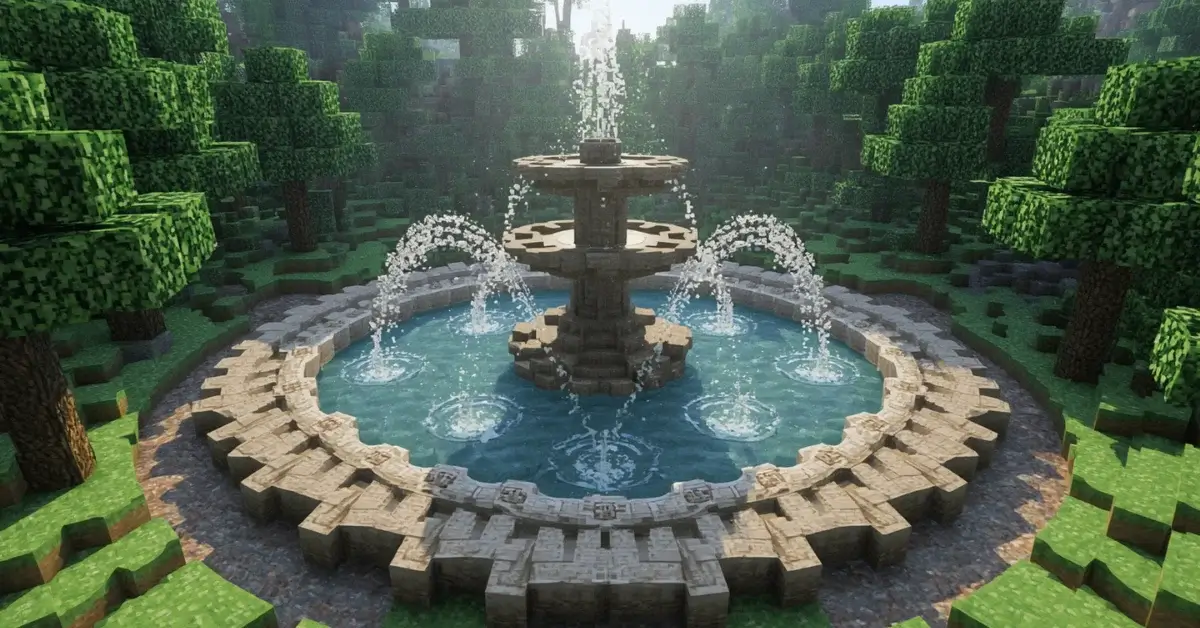
Minecraft Fountain Design Ideas Using Circles
A fountain is one of the smallest circular builds on this site, but getting the basin size, water placement, and surrounding details right makes the difference between a convincing centerpiece and an oversized decorative pond.
A fountain’s basic structure is simple: a raised outer rim, a shallow basin inside it, and a water source at the center, usually elevated above the basin so water visibly flows or spills downward. What separates a well-proportioned fountain from an oversized pond with a rock in the middle is mostly about scale — a fountain needs to read as a deliberately small, contained feature, which means getting the basin diameter and the central spout’s relative height right matters more here than in almost any other circular build on this site.
Sizing the basin
7 to 11 blocks in diameter suits most standalone fountains — large enough to read clearly as a circular basin rather than a plain water block, small enough to still leave surrounding space for paths, benches, or garden beds around it. Going much larger than 11–13 blocks starts to blur the line between a fountain and a decorative pond, since the basin’s size begins to dominate the courtyard or plaza around it rather than acting as a focal point within it.
| Basin diameter | Best for |
|---|---|
| 5–7 blocks | Small courtyard corners, garden accents |
| 9–11 blocks | Standard plaza or village-square centerpiece |
| 15+ blocks | Grand estate or palace courtyard fountains |
The basic single-tier fountain
Build the basin as a shallow filled circle, one block deep, with a raised outer rim (typically stone brick, quartz, or a similar decorative block) one block tall around the edge. At the exact center — an odd diameter makes this a clean single block — raise a short pillar one or two blocks above the basin’s rim, and place a water source at the very top of that pillar. The water spills downward and pools naturally in the basin below, with the raised pillar giving the visual effect of water actively flowing rather than just sitting still in a pond.
Get the exact basin blueprint for any diameter, with the center point clearly marked for the spout.
Open the Circle GeneratorTiered fountains
A tiered fountain stacks two or three progressively smaller circular basins on top of each other, each one elevated above the one below it, with water spilling from the smallest top tier down through each level to the largest basin at the bottom. A common proportion: a 3–5 block top tier, a 7–9 block middle tier, and an 11–13 block bottom basin, each one a smaller concentric circle than the tier below it and each raised on its own short pedestal. Gaps or notches in each tier’s rim let water spill down to the next level rather than pooling indefinitely at the top, mimicking how a real tiered fountain’s water cascades from level to level.
Getting the water flow to look natural
Water in Minecraft flows outward and downward from a source block following the game’s standard flowing-water rules, spreading across open surfaces and falling through any open vertical gap. For a fountain, this means the visual “flow” comes from deliberately leaving specific gaps or lower points in each tier’s rim rather than trying to control water with anything more complex — a single one-block gap in an otherwise solid rim tier is usually enough to create a visible cascade point without needing multiple gaps that end up looking chaotic instead of deliberate.
Decorative variations
- Statue centerpiece. Replacing the plain central pillar with an armor stand or a sculpted block arrangement gives the fountain a distinct visual anchor beyond the water itself.
- Colored or glowing water effect. Placing sea lanterns or glowstone just beneath the surface of the basin (underwater, where it won’t interrupt the water’s flow) creates a soft glow through the water, especially effective at night.
- Surrounding planters. A ring of flower beds or small hedges just outside the basin’s rim frames the fountain and reinforces its role as a courtyard or garden centerpiece.
- Seating ring. A low wall or a ring of benches set back a short distance from the basin invites the fountain to double as a gathering spot rather than a purely visual feature.
Multi-basin garden arrangements
Rather than one large central fountain, a garden or courtyard can use several small circular basins (5–7 blocks each) connected by short, narrow water channels, creating a more elaborate flowing arrangement across a wider area than a single fountain would cover. This suits larger palace gardens or estate grounds better than a single oversized basin, since it distributes the water feature across the whole space rather than concentrating it in one spot.
Oval and non-circular fountain basins
A plain circular basin suits most standalone placements, but a long, narrow plaza or a fountain built into an existing rectangular courtyard often suits an oval basin better, using the same width-and-height-independent sizing as any other oval build. The central-spout and tiered-basin techniques described above work identically on an oval footprint — the water mechanics don’t change based on the basin’s outline shape, only its proportions.
Placement considerations
A fountain works best as a genuine focal point — centered in a plaza, at the convergence of several paths, or in the middle of a courtyard where sightlines naturally draw toward it — rather than placed incidentally along one edge of a space. Because fountains are relatively small and low compared to surrounding buildings, they benefit from open sightlines toward them from multiple directions; a fountain tucked into a corner or blocked by taller structures nearby loses much of its impact as a centerpiece regardless of how well it’s built.
Common mistakes with this build
- Basin too large for its setting. An oversized basin overwhelms the surrounding plaza rather than serving as an accent within it.
- No visible flow. A raised center block with a water source but no gap or drop for the water to visibly move through reads as a static pond feature rather than a fountain.
- Skipping the rim. A basin without a raised, clearly defined outer edge blends into surrounding flooring rather than reading as a distinct fountain.
- Overcomplicating the water mechanics. Elaborate multi-gap tiers with water spilling in too many directions at once often look more chaotic than a single clean cascade point per tier.
A practical build order
Lay out the basin’s outline first, using the same anchor-point and quadrant-mirroring method as any other circle — center point, four extreme points, then the curve. Build the raised rim next, then dig or fill the basin interior to its finished depth before adding any water. Place the central pillar and its water source only after the basin itself is fully shaped and the rim is complete, since adjusting a basin’s size after water has already been placed tends to create awkward partial refills and stray water blocks that are more tedious to clean up than simply finishing the dry structure first.
Quick material reference
| Section | Suggested materials | Purpose |
|---|---|---|
| Basin floor | Prismarine, quartz, smooth stone | Reads clearly through the water |
| Outer rim | Stone brick, quartz, andesite | Defines the basin’s edge clearly |
| Central pillar | Quartz pillar, stone brick, polished blocks | Elevates the water source for visible flow |
| Surrounding paving | Smooth stone, andesite, gravel path | Frames the fountain within its plaza |
Matching the fountain to its architectural setting
A fountain built in front of a grand stone building or palace benefits from matching or complementary materials — quartz and stone brick alongside a similarly toned facade reads as a cohesive, planned space rather than two unrelated builds placed near each other. A fountain in a more rustic village setting works better with simpler materials like cobblestone or andesite, avoiding overly polished blocks that would clash with a village’s generally weathered, informal aesthetic. This matters more for fountains than for larger structures like towers, since a fountain’s small scale means it sits close enough to nearby buildings that any material mismatch is immediately obvious.
Nighttime appearance and lighting
A fountain lit only by ambient daylight effectively disappears from view at night, which is worth avoiding for a feature meant to be a persistent centerpiece. Placing lanterns or torches around the basin’s rim, or using the underwater-glowstone technique described earlier, keeps the fountain visible and attractive after dark. This also serves a practical purpose beyond aesthetics: a well-lit plaza around the fountain discourages hostile mob spawns nearby, which matters if the fountain sits in an area players walk through regularly rather than a purely decorative zone.
Seasonal and thematic variations
The same basin-and-tier structure adapts easily to different themes without changing its core proportions. A frozen or ice-themed fountain can use packed ice or blue-tinted blocks in place of standing water for a wintry courtyard. A more overgrown, naturalistic fountain works well with moss, vines, and lily pads softening the rim’s edges rather than a crisp, formal stone border. In every case, the underlying basin sizing and water-flow principles from this guide stay the same — only the surface materials and surrounding decoration change to fit the setting.
Maintaining the finished fountain
A fountain built correctly the first time needs very little upkeep, but it’s worth checking periodically that the central water source hasn’t been accidentally broken or replaced by later construction nearby, since a fountain missing its source block quickly drains to a dry basin. Keeping the surrounding area clear of encroaching builds also preserves the open sightlines that make a fountain work as a centerpiece in the first place — a fountain gradually boxed in by later additions loses much of its original visual purpose even if the structure itself remains intact. Revisiting the basin’s proportions against its surroundings occasionally, especially after nearby buildings are added or expanded, keeps the fountain reading as the intended focal point rather than an afterthought that got crowded out over time.
Frequently asked questions
What size should a Minecraft fountain basin be? +
7 to 11 blocks in diameter suits most courtyard or plaza fountains — large enough to read as a basin, small enough to leave surrounding space for paths and seating.
How does water flow correctly in a tiered fountain? +
Water source blocks at the top tier spill downward through gaps in each tier’s rim, following standard flowing-water mechanics — each lower tier just needs an opening for the water to fall through.
Can a fountain use a design other than a plain circle? +
Yes. Oval basins suit long plazas, and multiple small circular basins connected by channels create a more elaborate garden-style arrangement.