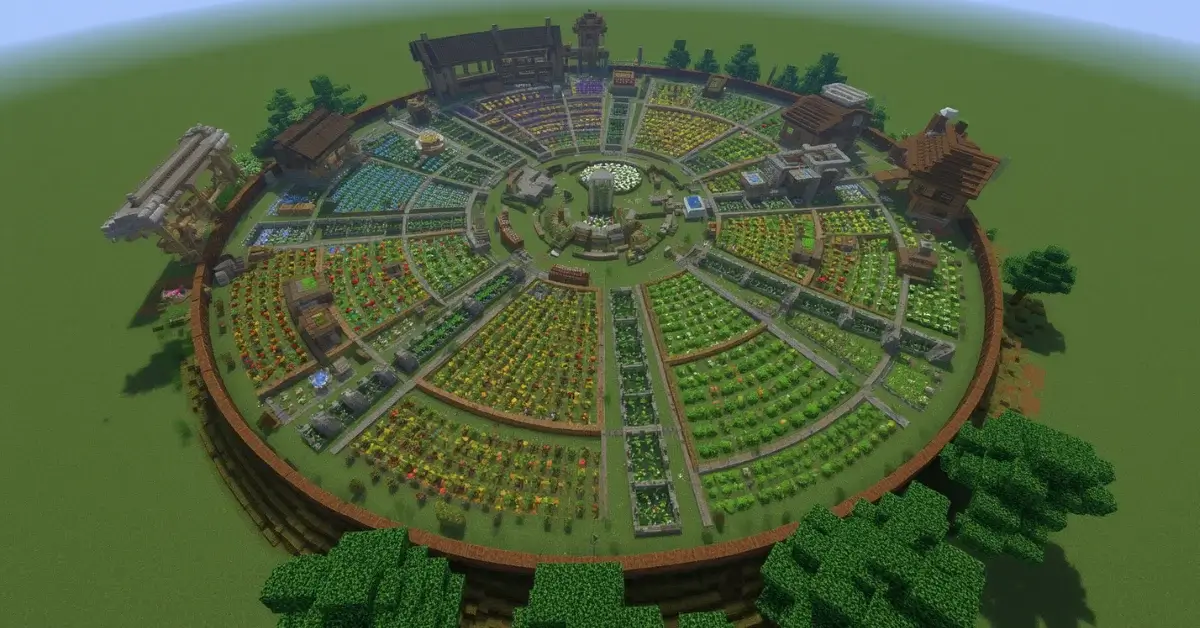
How to Build a Circular Farm in Minecraft (Efficient Layouts)
A round farm plot isn’t just a style choice — it matches the actual shape of a water source’s hydration range better than a square plot does, which means less wasted farmland and fewer water sources needed overall.
A single water source block hydrates farmland out to 4 blocks away in every direction, including diagonally — and that hydration range is, geometrically, a circle centered on the water. A square farm plot built around one water source either leaves the corners of the square outside hydration range if it’s sized to fit the water’s reach, or wastes usable space if it’s sized to fit inside the circle. A circular plot solves this directly: every tile at the plot’s edge sits at the same distance from the center water source, so the whole plot gets even hydration with no wasted farmland and no corners left dry.
The core plot: a 9-block circle around one water source
A 9-block diameter circle, centered on a single water source block, gives a radius of roughly 4 blocks from center to edge — matching the standard hydration distance almost exactly. This is the basic repeatable unit for a circular farm: one water block in the middle, farmland tiles filling the surrounding circle, and crops planted across the whole plot with confidence that every tile stays hydrated without needing a second water source anywhere nearby.
| Plot diameter | Water sources needed | Best for |
|---|---|---|
| 9 blocks | 1 (centered) | Single small plot, garden-scale farming |
| 17–21 blocks | 1 center + outer ring (see below) | Medium farm needing more than one hydration zone |
| 31+ blocks | Multiple plots tiled together | Large-scale automated or semi-automated farms |
Scaling up: tiling multiple circular plots
Rather than trying to stretch a single water source’s hydration range across a large farm — which doesn’t work, since the 4-block range is fixed regardless of farm size — the efficient approach is tiling multiple 9-block circular plots next to each other, each with its own centered water source. Arranged in a honeycomb-style pattern, adjacent circular plots can share edges efficiently with minimal gap between them, covering a much larger total area while keeping every individual plot’s hydration even. This is the same principle full-scale efficient farms use regardless of shape — multiple properly spaced water sources rather than one source trying to cover an oversized area — but the circular unit shape wastes less farmland per water source than a square grid does.
Lay out a single plot or a full tiled grid with an exact blueprint before placing any farmland.
Open the Circle GeneratorBorder and pathing
A ring of path blocks or a low fence just outside the farmland circle marks the plot’s edge clearly and gives a clean walking loop around it for harvesting without trampling crops mid-plot. For larger tiled farms, running the same path-ring treatment around each individual 9-block plot, rather than only around the farm’s outer perimeter, keeps every plot individually walkable and makes it easy to identify where one hydration zone ends and the next begins.
Circular vs. oval farm plots
A plain circular plot suits a standalone garden or a single hydration zone well, but a farm built along a specific strip of land — beside a river, following a road, or fitting a particular building footprint — often suits a stretched oval plot better than a series of separate circles. An oval plot still needs to respect the same 4-block hydration limit from its water source or sources; a long, narrow oval typically needs more than one water source spaced along its length rather than a single centered one, since one water block’s 4-block range can’t stretch to cover a very elongated shape on its own.
Choosing crops for a circular layout
Any standard crop — wheat, carrots, potatoes, beets — works the same way in a circular plot as a square one; hydration and light requirements don’t change based on plot shape. What circular plots do especially well is mixed-crop gardens, where each ring or wedge of the circle holds a different crop, giving a visually organized farm that’s still easy to navigate and harvest in sections without needing straight-line divisions that fight against the round shape.
Lighting for consistent growth
Crops need adequate light to grow, and a circular plot’s evenly-distributed shape makes it straightforward to light evenly from a small number of sources — a single elevated light fixture at the plot’s center, or a ring of lanterns just outside the farmland border, reaches every tile in a 9-block plot without needing lights scattered unevenly across the interior the way an oddly-shaped plot might.
Automated vs. manual circular farms
Circular plots work equally well for manual harvesting and for automated redstone-based farms using observers and pistons, since the hydration and layout logic is identical either way — the shape decision affects land use efficiency, not whether automation is possible. For automated builds, keeping the water source position consistent and centered in each tiled unit makes it easier to run collection systems (hoppers, water-stream harvesting) that rely on a predictable, repeated layout across every plot in the farm.
When a square plot is still the better choice
Circular plots aren’t universally better — a farm built to exactly match an existing rectangular building footprint, or one that needs to tile edge-to-edge with zero gaps across a large rectangular area, is often simpler as a square grid despite the small amount of extra wasted corner farmland. The circular approach earns its efficiency specifically around single, centered water sources; for a farm plan already built around a grid of evenly spaced water channels, a square or rectangular plot may end up just as efficient with far simpler construction.
Getting water source placement exactly right
The entire efficiency argument for a circular plot depends on the water source actually sitting at the true geometric center of the circle, not just approximately in the middle. On a 9-block diameter circle (an odd number), that center is a single block — placing the water source there means every point on the plot’s edge is genuinely equidistant from it. If the plot were built at an even diameter instead, the “center” would be a small cluster of blocks rather than one, which complicates hydration slightly since the water source then sits off from true center by half a block in one direction. This is a direct case where the odd-vs-even diameter decision has a functional consequence rather than just a visual one — for a circular farm plot built around a single water source, an odd diameter is generally the more reliable choice.
Vertical stacking for space-limited builds
Where horizontal space is limited — a small island, a confined base interior, or a build competing with other structures for footprint — circular farm plots stack vertically just as well as they tile horizontally. A tower of 9-block circular plots, one per floor with a light source and a water source centered on each level, multiplies a farm’s total yield without expanding its footprint at all. This does add a vertical access requirement (a ladder or stairs connecting each floor) that a single ground-level farm doesn’t need, but for builds where land area is the limiting factor rather than access convenience, it’s a straightforward way to scale a circular farm’s output.
A worked example: sizing a farm for expected yield
Consider a build that needs roughly 150 farmland tiles for a steady supply of wheat. A single 9-block circular plot yields somewhere around 55–60 usable farmland tiles once the center water block and the plot’s rounding are accounted for. Tiling three such plots in a honeycomb arrangement comfortably covers the 150-tile target with some margin, using three water sources total rather than trying to force a single oversized plot to work with one. Working backward from a yield target to the number of tiled plots needed — rather than picking an arbitrary large single circle and hoping the hydration math works out — is the more reliable planning approach for any circular farm above a single-plot scale.
Common mistakes with circular farm layouts
- Sizing the plot larger than the hydration range supports. A 15 or 21-block single circular plot with only one centered water source leaves the outer ring of farmland outside the 4-block hydration range, even though the shape still looks like a clean circle.
- Placing the water source off-center. Even a one-block offset from true center creates an uneven hydration edge on one side of the plot, undermining the whole reason for choosing a circular layout in the first place.
- Ignoring light levels while focusing only on hydration. Water access and light access are separate requirements; a fully hydrated plot sitting in low light still won’t grow crops at a normal rate.
- Tiling plots with large gaps between them. Leaving excess unused space between adjacent circular plots defeats the space-efficiency argument for choosing circles over a simpler layout in the first place.
Integrating a circular farm into a larger base
A circular farm doesn’t need to sit in isolation — tiled plots work well as a courtyard centerpiece surrounded by a circular or oval outer wall, as a ring-shaped garden with a building or statue at the very center (leaving the innermost ring open rather than farmed), or as a series of terraced circular plots built into a hillside. In each case, the underlying 9-block-plot-per-water-source unit stays the same; what changes is how the plots are arranged relative to the rest of the build around them.
Maintenance and long-term upkeep
A well-planned circular farm needs less ongoing correction than an improvised one, mainly because the hydration and lighting groundwork is right from the start rather than patched in after crops start failing to grow in specific spots. Periodically checking that the center water source in each tiled plot hasn’t been accidentally replaced or drained, and that any light sources haven’t been broken or blocked by later additions nearby, keeps a circular farm producing consistently over the long run without needing to redesign the layout later.
Frequently asked questions
Why build a circular farm instead of a square one? +
A water source hydrates farmland within 4 blocks in every direction — a circular area. A circular plot matches that range exactly, so no farmland sits outside watering range or wastes space near the water source.
What is the ideal diameter for a single circular farm plot? +
A 9-block diameter circle centered on one water source covers the full hydration range efficiently, matching the standard 4-block hydration distance.
Can circular farm plots be tiled together for a larger farm? +
Yes. Repeating 9-block circular plots in a grid or honeycomb pattern, each with its own water source, scales the layout to any size while keeping every plot fully hydrated.